Last known major update
September 9, 2026
The MCP server gained authenticated generation of saved reviews.
Official announcementAbout the tool
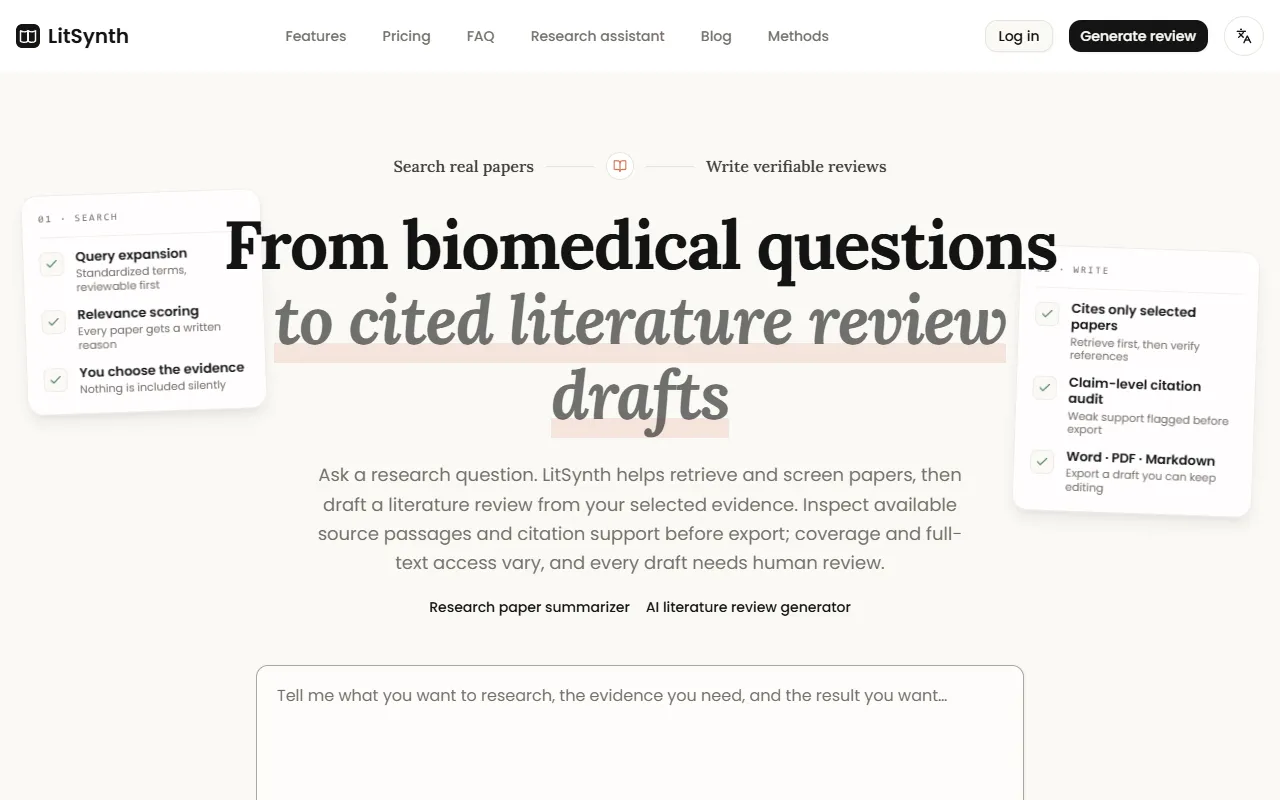
LitSynth is an AI literature review generator built mainly for biomedical and health research. You type a research question or upload PDFs, and it turns the question into standardized search terms and a retrieval plan you can check before anything runs. It then searches PubMed, Europe PMC, OpenAlex and Crossref, gives every paper a relevance score with a written reason, and lets you choose which papers go into the review. Nothing is included without your selection. The draft cites only the papers you selected. You can click a citation to see the matching passage, and a claim-level citation audit flags statements with weak support before you export to Word, PDF or Markdown. Other tools cover research gap finding, paper summaries, PubMed search strategies and a Systematic Review Beta with protocol notes, title and abstract screening, evidence tables and audit records in a PRISMA-lite workflow. LitSynth states that this beta does not claim full PRISMA 2020 compliance, dual independent screening or meta-analysis. A deep research mode runs longer searches, and an authenticated MCP connection lets Codex generate saved reviews. LitSynth is run by Pengju, LLC in Cheyenne, Wyoming, which also makes LitSource. Credits pay for the work: a paper search costs 1 credit, a standard review 25 credits, a Systematic Review Beta 100 credits and a finished deep research write 100 credits. The Free plan gives 30 credits a month for one demo review of up to 10 papers with Markdown download. A one-time $4.90 Trial gives 50 credits for 30 days. Plus costs $12.90 a month or $129 a year for 500 credits a month, saved projects, Word and PDF export and 6 deep research runs. Pro costs $39.90 a month or $399 a year for 2,000 credits, up to 50 papers per review, Systematic Review Beta and 20 deep research runs. Unused credits are refundable within 7 days of purchase.
Key use cases
Content Writing
AI content generation for blogs, websites and more. Draft new pieces, edit them and improve your writing.
Document Summarization
Get the key points of long reports, articles and manuals without reading every page.
API & developer readiness
LitSynth has no public REST API. Its MCP interface offers read-only public tools for release notes, screening benchmark results and screening protocol validation, and an authenticated mode where Codex reads your review runs and generates cited reviews from papers you already selected. Access uses scoped, expiring tokens created in Settings, Security, and generation uses your account credits.